
6 min read
How to clean a microfiber couch without ruining it
By Dan, owner & lead technician·Updated June 15, 2026
Microfiber is the most common sofa fabric we clean in North Jersey, and it's genuinely durable — right up until someone attacks a spill with a soaking wet rag and dish soap. Then you get a ring that's harder to remove than the original stain. Here's how to handle the everyday stuff yourself, and how to tell when a spot is past the DIY line.
Short answer
Find the tag's cleaning code first: “W” means a water-based cleaner is safe, “S” means solvent only (water leaves rings), “W/S” means either, “X” means vacuum only. Vacuum, spot-test, work edge-to-center, and dry fast. Set-in body oil and S-code water rings usually need a pro.
Read the tag before you touch it
Every piece of upholstery has a cleaning code, usually on a tag under a cushion or along the deck. It's four letters and it decides everything:
- W — water-based cleaner is safe. Most synthetic microfibers are W.
- S — solvent only. Water will leave a ring on this fabric, so it needs a dry-cleaning solvent. A lot of “faux-suede” microfiber is S.
- W/S — either water or solvent is fine. The most forgiving code.
- X — vacuum only, no liquid at all. Rare, but if you see it, stop here and call a pro.
Start with a vacuum, every time
Most of what makes a microfiber couch look tired isn't a stain — it's dry soil, crumbs, dust, and pet dander worked into the nap. Vacuum the whole piece with an upholstery attachment before you do anything wet, including under and behind the cushions. On a lot of couches this alone is 70% of the result.
If the nap looks matted or blotchy after vacuuming, a soft brush in one direction lifts it back up. Don't scrub in circles — that's what causes the permanent shiny patches you've probably seen on an older microfiber sofa.
Water-based spots on a W or W/S couch
Mix a few drops of a mild, dye-free dish soap into a cup of distilled water (tap water minerals can leave their own mark). Dampen — don't soak — a clean white microfiber towel, and blot the spot from the outside edge toward the center so you don't spread the ring outward.
Blot, don't rub. Switch to a clean part of the towel as soil transfers. Then go over the area with a second towel dampened in plain distilled water to rinse the soap out, and dry it fast with a fan or hair dryer on cool. Speed-drying is what prevents a water ring as the fabric dries.
Grease and body-oil stains — the headrest problem
The dark, slightly shiny patches where everyone's head and arms land are body oil, and water alone won't touch them. On a W/S or S fabric, a small amount of a dry-cleaning solvent (the kind sold for upholstery) on a white cloth, dabbed gently, breaks the oil down. Always test it first in a hidden spot like the back corner of the deck.
This is also the stain that most often beats a homeowner. Oils build up in layers over months, and by the time the patch is obvious it's deep in the fiber. We pre-treat it with a solvent-safe degreaser and pull it with a low-moisture hand tool — more aggressive than anything that's safe to do with a rag.
The two mistakes that cause permanent damage
First: using water on an S-code fabric. The fabric isn't waterproof — it's that the dyes and the backing react to water and leave a halo that doesn't dry out evenly. If your tag says S and the spill is anything but solvent-friendly, that's the moment to call rather than experiment.
Second: over-wetting any microfiber. Soaking the cushion drives the spill down into the foam, where it wicks back up as a ring hours later and can grow mildew you'll smell before you see. Light moisture and fast drying beats a heavy soak every single time.
When it's worth calling instead
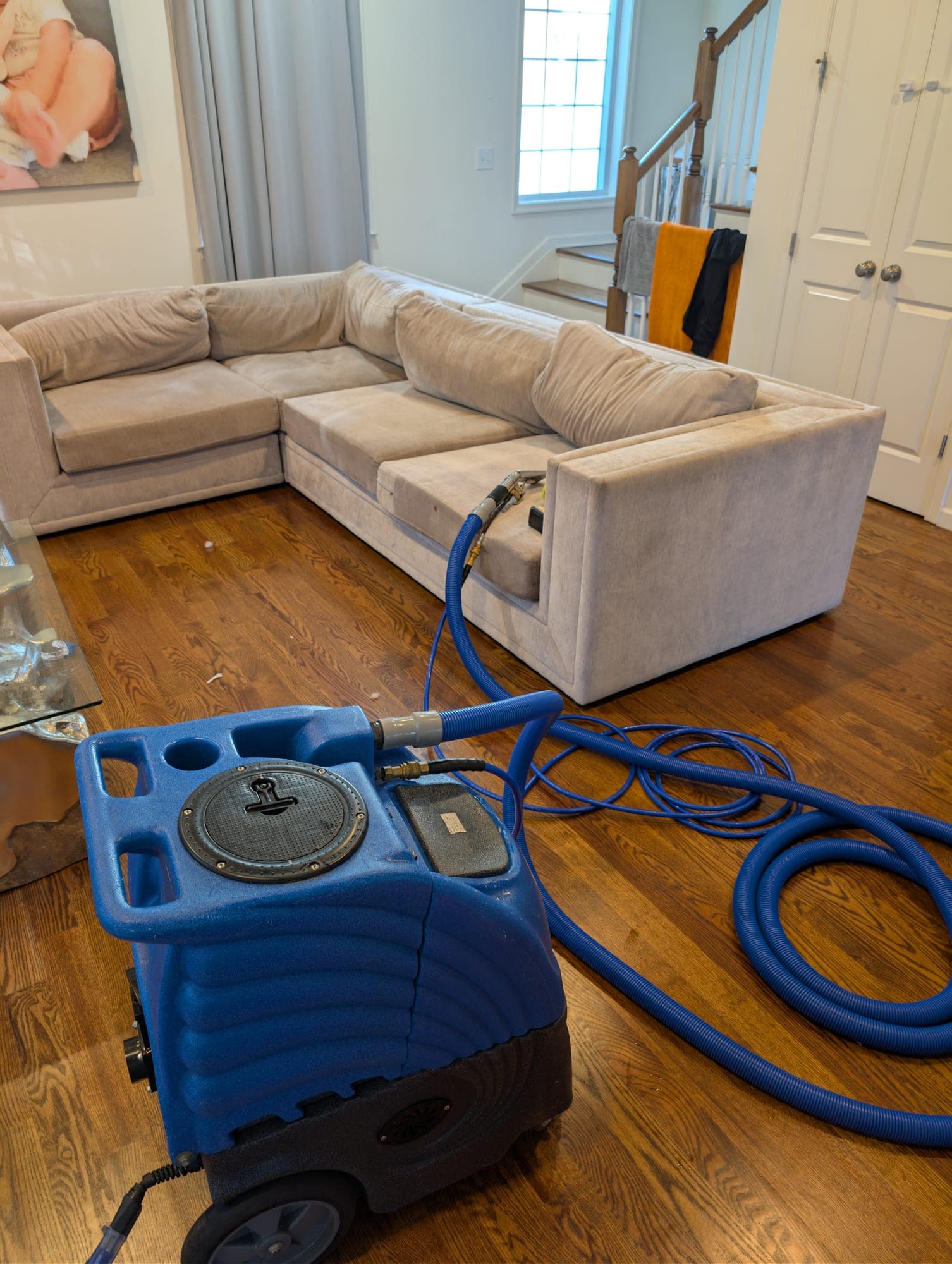
If the code is S or X, if the whole couch is dingy rather than spot-stained, if there's set-in body oil, or if a pet has gotten into the cushions, a professional extraction will do in an hour what hours of blotting won't. We colorfast-test first, clean for the specific fabric, and dry it evenly so you don't trade a stain for a ring.
Owner-to-owner: there's no shame in a couch that's just past home remedies. Microfiber that's been deep-cleaned properly often looks years younger, and it's a fraction of replacing the piece.
Related service
Upholstery Cleaningin Lyndhurst & nearby NJ →Microfiber, polyester, olefin, cotton blends, linen, and viscose. Colorfastness tested, low-moisture extraction, even drying.
Upholstery in your town
Free written quote
Text a photo, get the real price — before we ever drive over.
Upholstery Cleaning starts at $139 (per sofa). Dan prices every job from photos, so the number you get is the number you pay — no surprise upcharges at the door. Fastest way: call or text (551) 205-5995.